This study proposed to evaluate the colonization of the gastrointestinal tract after the utilization of Il Kluyveromyces marxianus fragilis B0399. It is clearly demonstrates its ability of resistance to the gastric barrier and suggests that it can be effectively taken even at much lower dosages than those examined. Also noteworthy, since it is a probiotic composed of yeasts, Kluyveromyces fragilis marxianus B0399 could be taken together with antibiotics.
Giorgio Mustacchi (Oncological Centre, Local Health N1-Trieste; Trieste University) ; Antonio Miclavez ; Alessandro Turello;
Franca Bearzi;Flaviano Collavini; Paolo Valles.
This study proposed to evaluate the colonization of the gastrointestinal tract after the utilization of Il Kluyveromyces marxianus fragilis B0399. The product was administered to 17 healthy volunteers for a period of 14 day.The intake of Kluyveromyces fragilis marxianus B0399 B0399 on the part of the healthy subjects at the dosage of 20 million CFU/diem for 2 weeks proves to be more than sufficient for intestinal colonization to take place without any side effects.
It is clearly demonstrates its ability of resistance to the gastric barrier and suggests that it can be effectively taken even at much lower dosages than those examined.
Also noteworthy, since it is a probiotic composed of yeasts, Kluyveromyces fragilis marxianus B0399 could be taken together with antibiotics.
SUMMARY
Kluyveromyces marxianus fragilis B0399 is a probiotic yeast used as a dietary supplement. This study proposed to evaluate the colonization of the gastrointestinal tract after the utilization of Il Kluyveromyces marxianus fragilis B0399.
The product was administered to 17 healthy volunteers for a period of 14 day. The feces of the subjects were analyzed to evaluate the presence of Kluyveromyces marxianus fragilis B0399at T0 (time zero), before the administration of the product (absence verification) and then at the end, after 14 days (T14 – tempo 14.)
The intake of Kluyveromyces fragilis marxianus B0399 on the part of the healthy subjects at the dosage of 20 million CFU/diem for 2 weeks proves to be more than sufficient for intestinal colonization to take place without any side effects.
The elevated magnitude of the colonization found clearly demonstrates its ability of resistance to the gastric barrier and suggests that Kluyveromyces fragilis marxianus B0399 can be effectively taken even at much lower dosages than those examined (for example: 5–10 million CFU/diem).
After examining various official trials in the animal field, it becomes questionable or even inopportune to excessively increase the daily dosage.
Also noteworthy, since it is a probiotic composed of yeasts, Kluyveromyces fragilis marxianus B0399 could be taken together with antibiotics. These characteristics, together with the absence of side effects, demonstrate a profile not only of effectiveness but of convenience and safety in usage, worthy of further scientific investigation.
1 – Researchers and facilities involved in the experimentation
Giorgio Mustacchi (Centro Oncologico Azienda per i Servizi sanitari N° 1 – triestina, Università degli Studi di Trieste): ): Head of the experimentation and statistic calculation.
Antonio Miclavez, CSM s.r.l Trieste, promoter of the study
- Alessandro Turello, Laboratori Turval s.r.l. : owner of the active ingredient (attachments A1,A2)
- Franca Bearzi, Laboratorio analisi della Casa di Cura Pineta del Carso (Aurisina- Trieste), preparation of the sample in suspension. (attachment B)
- Flaviano Collavini, CATAS S.p.a, Laboratorio ambiente e agroalimentare (laboratorio microbiologico), CCIAA di Udine ( Allegato C)
- Paolo Valles, microbiologist, Analysis at the microscope (Allegato D)
INTRODUCTION:
The intestinal bacterial flora has a key role in both nutrition and health maintenance and, in its complexity and function, plays a unique role in our organism. Several thousand different bacterial species are present in the human intestine, some considered beneficial (ex. bifidobacteria, lactobacilli, lactic yeasts) and others benign (ex. Methanogens and sucrose species of Clostridum and Bacterium) capable of contrasting the excessive multiplication of species dangerous to human health (proteolytic species of Bacteroium, Clostridium difficile, C perfrigens and the pathogen species of Enterobacteria).
Probiotics are microorganisms with the ability to bypass the gastric barrier and favor the modulation of the intestinal bacterial flora capable of surviving and maintaining viability for long periods of conservation and be harmless for man.
By introducing foods with the addition of probiotics, the useful bacteria can survive the journey through the gastroenteric tract and reach the colon. They colonize it, altering favorably the microbial equilibrium.
Probiotics have shown to be useful in the treatment of a number of intestinal problems, such as childhood diarrhea, traveler’s diarrhea and certain chronic inflammatory diseases of the intestine.
Objective of the study
The object of this study was to verify and evaluate the ability of Kluyveromyces marxianus fragilis B0399 to bypass the gastric barrier and to colonize in the intestinal tract when administered at the normal dosages suggested by the distributing company.
Some notes on the active ingredient utilized in the trial.
Kluyveromyces marxianus fragilis B0399 is a lactic yeast with characteristics which are different from those of lactobacilli and of bifidobacteria, and of the yeast Saccharomyces. It has been used for some time now as a probiotic in the zootechnical field as well (Commission Regulation EC 773/06). It is a eucaryotic type of cell (Lachance M.A 1) endowed with an elevated lactasic enzymatic activity (β-galactosidase). It ferments lactose with the production of lactic acid. The enzymatic activity, in anaerobic conditions typical of the intestine, is of a homofermenting type, in that it transforms all the resulting glucose is lactic acid, without the production of gas (C02) (ex.Saccharomyces) (Vananuvat-Kinsella2 ,Wasserman-Hopkins-Porges3). This contributes in modulation the intestinal environment, rducing the pH. Furthermore, it has shown to be particularly resistant to the action of antibiotics (Voughan 4 ).
Kluyveromyces marxianus fragilis B0399 appears to be capable of resisting gastric shock. This ability was also tested in vitro (Susmel and Stefanon5 ) by measuring the fermenting capacity before and after gastrointestinal digestion. The resistance to digestion proved to be elevated.
The ability of bypassing the gastric barrier was confirmed also by trials in vivo on monogastric animals like piglets, whose digestive apparatus is very similar to the human apparatus (Lovrovich P. 6 ) and on horses, by testing the presence of Kluyveromyces B0399 in the feces and the modification of the pH in the colon ( Lowell R. S. 7. Susmel-Stefanon 8,Bosi P. 9.)
The beneficial aspects of Kluyveromyces B0399 have also been indicated by the various studies regarding problems of the colon as well (Andreoli S.10, Irvine EJ 11, Bottona-Parisi-Zilli 12).
MATERIALS AND METHODS
As stated by the producing company (Turval Laboratories srl of Udine) the strain utilized is Kluyveromyces fragiilis marxianus B0399, deposited in BCCM-Belgium Coordinated Collections of Microorganisms, Culture Collection Mycoteque de l’Université Catholique de Lovain (Belgium) with the mark B0399, (Attachmentsi A, A2).
The experimentation was set up using guidelines from a project with the same objectives “Colonization and Immunomodulation by Lactobacillus reuteri ATCC 55730 in the Human Gastrointestinal Tract” (Valeur 13 ).
3.3.4 – Product object of the study and dosage
Products in capsule found on the market and already notarized by the Ministry of Health were used: Biosympa, which is normally found in pharmacies.
As certified by the producing company, Turval Laboratories Italia s.r.l, the product Biosympa is produced with 40 million (40*106 ) ufc/g (Attachments A, A1, A2).
The product “Biosympa” containing the active ingredient Kluyveromyces marxianus fragilis B0399, was administered at the dosage of two capsules per day (20*106 cfu per caps.), for a total daily dosage of 20*106 ufc di Kluyveromyces B0399, for 14 days.
3.1 – Enrolled subjects
17 healthy volunteering subjects of age were enrolled, (median 53, range 35-72 years old), 3 males and 14 females.
The evaluation of their state of health was done through a medical consultation to gather all t case-history information considered to be necessary. In particular, subjects were asked which drugs, if any, they had used during the six months prior to experimentation, if they’d had any recent diseases/pathologies, if they had any symptoms at present and what was the typology of their everyday diet.
Criteria for exclusion
Subjects were excluded who: in the three months prior to the experimentation had taken antibiotics or probiotics, had a severe chronic disease and/or other affection of the colon which results in the fragility of the mucosa,celiac, had intestinal obstruction orsub-obstruction, had previous abdominal surgery with the exception of hernia or appendectomy, had taken antipsychotic drugs in the previous 3 months or steroids in the previous month, were lactose intolerant or immune deficient, poor compliance.
During the period of treatment the assumption of the following were not allowed: drugs which could alter the intestinal motor function or absorption intestinal, including laxatives and anti-diarrhea medications, products able to alter the intestinal bacterial flora (antibiotics and products containing probiotics).
Examination of fecal samples
The feces of the people participating were analyzed for the verification of the presence of Kluyveromyces marxianus fragilis B0399.
Before the beginning of the treatment with Kluyveromyces marxianus fragilis B0399, samples were taken at time T0 (time zero) with the aim of determining the initial state of the fecal composition.
To determine the evolution in time and the influence of the treatment with Kluyveromyces marxianus fragilis B0399, the analysis of fecal samples was repeated after 14 days of administration ( at time T14).
Initial criteria of evaluation
The test described here was conducted using the criteria recognized at the European level (Valeur 13 , EFSA 14 , , Francis C. Y 15).
With the aim of verifying the presence of Kluyveromyces marxianus fragilis B0399 in the feces, and not having any data regarding lactic yeasts, an increase in value in the feces superior to 103 ufc/g in accordance with the value taken in the reference study about lactobacillus reuteri (Valeur 13), would be considered significant.
Collection of sample:
The fecal matter was collected from each subject in sterile containers (BIO-BOX raccoglitore per ricevere il campione di feci, for.me.sa.) and delivered to the appointed doctor. All containers with fecal matter were carefully preserved in refrigeration at a constant temperature of 4°C.
Homogenization of the sample for the analyses
All the original samples were prepared with the aim of obtaining specimen as homogeneous as possible in order to execute the analysis and the count of the yeasts on a quantitative basis.
The laboratory prepared the suspension at known strength starting with the initial solid sample. The dilution of the fecal matter was done with sterile physiological solution.
The dates of collection and arrival of the samples are indicated in Tab 1.
Tab 1 Summary table of the dates of collection and arrival of the samples of both Time zero (T/0) and Time T/14.
|
Sample N
|
Collection date sample |
Arrival date sample |
Sample N
|
Collection date sample |
Arrival date sample |
|
|
|
|
|
|
|
|
1 T/0 |
23/06/09 |
24/06/09 |
1 T/14 |
06/07/09 |
07/07/09 |
|
2 T/0 |
23/06/09 |
24/06/09 |
2 T/14 |
06/07/09 |
07/07/09 |
|
3 T/0 |
23/06/09 |
24/06/09 |
3 T/14 |
06/07/09 |
07/07/09 |
|
4 T/0 |
‘23/06/09 |
24/06/09 |
4 T/14 |
06/07/09 |
07/07/09 |
|
5 T/0 |
23/06/09 |
24/06/09 |
5 T/14 |
06/07/09 |
07/07/09 |
|
6 T/0 |
23/06/09 |
24/06/09 |
6 T/14 |
06/07/09 |
07/07/09 |
|
7 T/0 |
23/06/09 |
24/06/09 |
7 T/14 |
06/07/09 |
07/07/09 |
|
8 T/0 |
23/06/09 |
24/06/09 |
8 T/14 |
06/07/09 |
07/07/09 |
|
9 T/0 |
23/06/09 |
24/06/09 |
9 T/14 |
06/07/09 |
07/07/09 |
|
10 T/0 |
23/06/09 |
24/06/09 |
10 T/14 |
06/07/09 |
07/07/09 |
|
11 T/0 |
23/06/09 |
24/06/09 |
11 T/14 |
06/07/09 |
07/07/09 |
|
12 T/0 |
23/06/09 |
24/06/09 |
12/ T/14 |
06/07/09 |
07/07/09 |
|
13 T/0 |
23/06/09 |
24/06/09 |
13 T/14 |
06/07/09 |
07/07/09 |
|
14 T/0 |
23/06/09 |
24/06/09 |
14 T/14 |
06/07/09 |
07/07/09 |
|
15 T/0 |
23/06/09 |
24/06/09 |
15 T/14 |
06/07/09 |
07/07/09 |
|
18 T/0 |
23/06/09 |
24/06/09 |
18 T/14 |
Sample non received |
Sample non received |
|
19 T/0 |
23/06/09 |
24/06/09 |
19 T/14 |
06/07/09 |
07/07/09 |
The main characteristics of the subjects studied and the dates of collection are indicated in Tab2.
Tab 2 : Characteristics of the subjects and times of collection
|
|
Subject |
Sex |
Age
|
SampleT/0 |
Sample T/14 |
||
|
N. of label |
Date |
N. of label |
date |
||||
|
1 |
A. S. |
F |
39 |
1 T/0 |
23.06.09 |
1 T/14 |
06.07.09 |
|
2 |
G. D. |
M |
50 |
2 T/0 |
23.06.09 |
2 T/14 |
06.07.09 |
|
3 |
R. C. |
F |
53 |
3 T/0 |
23.06.09 |
3 T/14 |
06.07.09 |
|
4 |
F. S. |
F |
49 |
4 T/0 |
23.06.09 |
4 T/14 |
06.07.09 |
|
5 |
D. A. |
F |
38 |
5 T/0 |
23.06.09 |
5 T/14 |
06.07.09 |
|
6 |
D. A. |
F |
38 |
6 T/0 |
23.06.09 |
6 T/14 |
06.07.09 |
|
7 |
S. L. |
F |
57 |
7 T/0 |
23.06.09 |
7 T/14 |
06.07.09 |
|
8 |
M. N. |
F |
66 |
8 T/0 |
23.06.09 |
8 T/14 |
06.07.09 |
|
9 |
C. M. |
F |
59 |
9 T/0 |
23.06.09 |
9 T/14 |
06.07.09 |
|
10 |
M. M. |
M |
72 |
10 T/0 |
23.06.09 |
10 T/14 |
06.07.09 |
|
11 |
G. G. |
F |
64 |
11 T/0 |
23.06.09 |
11 T/14 |
06.07.09 |
|
12 |
B. G. |
F |
70 |
12 T/0 |
23.06.09 |
12 T/14 |
06.07.09 |
|
13 |
C. L. |
F |
49 |
13 T/0 |
23.06.09 |
13 T/14 |
06.07.09 |
|
14 |
B. C. |
F |
55 |
14 T/0 |
23.06.09 |
14 T/14 |
06.07.09 |
|
15 |
M. L. |
F |
44 |
15 T/0 |
23.06.09 |
15 T/14 |
06.07.09 |
|
18 |
C. M. |
F |
35 |
18 T/0 |
23.06.09 |
18 T/14 |
06.07.09 |
|
19 |
C. A. |
M |
57 |
19 T/0 |
23.06.09 |
19 T/14 |
06.07.09 |
Analyses conducted on the samples obtained at time T 0
Count of total yeasts and elimination of interference of candida.
1) Presence and quantification of microorganisms (yeasts) positive on Sabouraud agar.
2) To eliminate the interference of candida , a screening of the colonies (of yeast) positive on Sabouraud agar was conducted through the identification of the colonies of Candida (Medium Chromoalbicans agar) and by their examination at the microscope (Phase contrast : 12.5 x 40).
Analyses conducted on samples obtained at time T 14
Count of total yeasts, elimination of interference of candida and verification of the presence of lactic yeasts Kluyveromyces) ,
1) Presence and quantification of the microorganisms (yeasts) positive on Sabouraud agar.
2) To eliminate the interference of candida, a screening, like above, of the colonies (of yeast) positive on Sabouraud agar was conducted through the identification of the colonies of candida (Medium Chromoalbicans agar) and an exam at the microscope was executed on all the plates (Phase contrast : 12.5 x 40)
3) The identification of Kluyveromyces : the method used (supplied by Turval Laboratories) was the one found in the dossier approved by the EU (norm 377/2006 ) for the identification of lactic yeasts (Kluyveromyces through sowing on Medium MV1 Agar specific to lactic yeasts. (Lab CATAS CCIAA UD all. C)
4) Observation at the microscope was conducted (Phase contrast: 12.5 x 40) (Dr. Valles) attachment D.
STATISTICS ANALYSIS:
The evaluation of the presence of the yeasts in the feces was determined using the following parameters: (Tab 3):
Negligible: (< 100 ufc/g)
Positive: (lactic yeast by identification on MV1 agar –medium selected for Kluyveromyces sp.)
Positive**: (lactic yeast by identification at the microscope.)
Non determinable*: (presence of patina)
The count (CFU) refers to the weight of the feces as it.
The difference between frequencies (positive/negative for the threshold level pre-selected between T0 and T14) was analyzed with the chi-square test. The analysis of the quantitative differences between T0 and T14 was evaluated with the “Two-Sample T-test” a one-tailed test ( Alpha=0.05). The analyses were executed with the software NCSS 2007 (NCSS Statistical software, Kaysville, Utah, USA).
RESULTS:
The results in 16/17 subjects enrolled were able to be evaluated (94.12 %)
At Time T/0. considering the results obtained by the total count of the yeasts and subtracting from them the count of the colonies of Candida Albicans, the presence of total yeasts was negligible or absent in 13 out of 17 samples (76.47 %). The remaining 4 had a minimal presence of colonies (Tab 3).
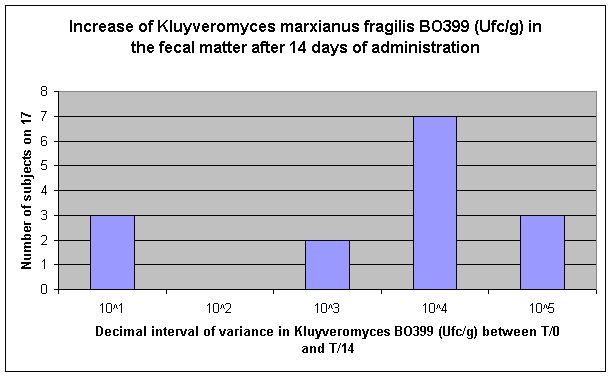
At Time T14 16/16 samples (100 %) resulted positive in terms of presence of yeasts, with a statistically significant increase (chi-square Test: X=19.2, p < 0.00001) compared to T0. Analogically, the quantitative evaluation between T0 and T14 shows a statistically significant difference in terms of presence of colonies (medium values 1373.33 versus 460873.30 (p = 0.035). The average increase was about 3 logarithms (range from 1 to 6). The increase appears to be major in cases where at Time T0 there was no trace of yeasts compared to those in which a negligible or modest presence was detected (Tab 3). At T/14 the yeasts or microorganisms positive on Sabouraud-agar through the identification test executed on MV1- agar on 7 randomly selected samples (3, 7, 9, 10, 12, 13, 19) all resulted in being lactic-fermenting yeasts (kluyveromyces marxianus/fragilis). (Tab 3). From the microbiological comparative exam executed at the microscope on all the samples Sabouraud-agar positive, results show that the isolated colonies can be identified in 100% of the cases exclusively with a lactic yeast (kluyveromyces marxianus fragilis). Tab 3: Evaluation of the presence of total yeasts in the feces (excluding candida) ‘ At Time 0 and 14 days and verification of lactic yeasts at Time 14
|
Sample N |
T/0 |
T/14 |
T/14 |
|
|
Total yeasts (excluding Candida) cfu/g |
Total yeasts (excluding Candida) cfu/g |
Lactic yeasts |
|
1 |
2×10³ |
7×10⁴ |
Positive** |
|
2 |
Absent |
5×10⁴ |
Positive** |
|
3 |
Negligible |
5.7×10⁴ |
Positive* |
|
4 |
4×10³ |
7 x 10⁴ |
Positive** |
|
5 |
Negligible |
2.5 x 10⁴ |
Positive** |
|
6 |
Negligible |
2.5 x 10⁴ |
Positive** |
|
7 |
Absent |
1.8 x 10⁵ |
Positive * |
|
8 |
6.5×10³ |
3 x 10⁴ |
Positive** |
|
9 |
7×10³ |
Non determinable* |
Positive* |
|
10 |
Negligible |
3.2 x 10⁵ |
Positive* |
|
11 |
Negligible |
2.5 x 10⁴ |
Positive** |
|
12 |
Negligible |
4.4 x 10³ |
Positive* |
|
13 |
Negligible |
1.7 x 10³ |
Positive* |
|
14 |
Negligible |
2.5 x 10⁴ |
Positive**
|
|
15 |
Negligible |
3 x 10⁴ |
Positive** |
|
18 |
Negligible |
Sample not available |
|
|
19 |
Absent |
1.5×10⁵ |
Positive* |
- Negligible: (< 100 UFC/g)
- Positive*: (lactic yeast by identification on MV1 agar –medium selective for Kluyveromyces sp.)
- Positive**: (lactic yeast by identification at the microscope)
- Non determinabile*: (presence of patina)
- Note : the count (CFU) refers to the weight of the feces as it.
Fig 5.1 Increase of Kluyveromyces marxianus fragilis BO399 (Ufc/g) in the fecal matter after 14 days of administration ( at time T14).
On the x-axis there is decimal interval of variance in Kluyveromyces BO399 between T/0 and T/14 (Ufc/g)
On the y-axis there are the number of subjects on 17.
Profile of toxicity
None of the subjects treated complained of any type of side effects.
This study demonstrated that the presence of yeasts ( different from candida) in the feces of healthy subjects is present in less than 25% of cases. It’s reasonable to think that these are yeasts different from Kluyveromyces fragilis marxianus B0399 (for instance, yeasts which are present in foods, like Sacccaromyces cervisiae and others which are similar) since none of the subjects in the study had taken the active ingredient in the three months preceding the testing.
In any case, the administration of Kluyveromyces fragilis marxianusB0399 at the pre-selected dosage of 20 M/die taken orally for two weeks is able to show very high levels of yeast in 100% of the subjects treated, and further analyses of confirmation proved it to be the lactic yeast Kluyveromyces fragilis marxianus B0399.
In our study we chose the threshold value of positiveness at T14, based on the reference literature (Valeur 13). This value, however, is in reference to lactobacilli (lacttobacilus reuteri) , usually saprophytes of the human intestine. The lactic yeast Kluyveromyces fragilis marxianus , as confirmed in the present study, is rarely present in a relevant amount, therefore it is reasonable to assume an even lower threshold of positiveness, of about 2 logarithms.
Apart from these considerations, the quantitative increase of the active ingredient present in the feces is considerable—it, in fact, varies from three to five logarithms.
The entity of the results is such that a colonization time of less than 14 days can be considered, and also the hypothesis of lower dosages, as seen in monogastric animal systems like piglets of 35kg, to whom, according to the European commission, 4.56 million CFU/die are sufficient. (Valles-Lugano16 , Commission Regulation (EC) 17, Bottona-Parisi-Zilli 12 )
It is also important to note the negligible interference of the gastric barrier which emerges
CONCLUSIONS:
The dosage of 20 million CFU/die taken by the healthy subjects for two weeks resulted in being fully sufficient for intestinal colonization , and with no side effects.
The elevated entity of the colonization found clearly demonstrates the capacity to resist the gastric barrier and can therefore be reasonable to think that Kluyveromyces fragilis marxianus B0399 could be effectively be taken at considerably lower dosages than those examined (for example 5- 10 million CFU/die)
To the contrary, it was observed that in the dietary trials conducted on monogastric animals of reference, such as piglets (Bosi 9), over-dosage (x 10 times) resulted in a worsening of the conversion index, (see dossier Kluyveromyces B0399 evaluated by the EFSA and approved by the European Commission (Bosi 9, Commission Regulation (EC) 17 ).
Therefore, it is probably ineffective or even inopportune to excessively increase the daily dosage (for example, more than a logarithm) without specific testing.
Also noteworthy, since it is a probiotic composed of yeasts, Kluyveromyces fragilis marxianus B0399 could be taken together with antibiotics. (Voughan 4)
These characteristics, together with the absence of side effects, demonstrate a profile not only of effectiveness but of convenience and safety in usage, worthy of further scientific investigation.
BIBLIOGRAPHY:
1. Lachance M.A. (1970) Kluyveromyces: systematics since Antoine van Leeuwenhoek 63: 95-104, 1993.
2. Vananuvat P. and Kinsella J.E. (1975) Production of yeast protein from crude lactose by Saccharomyces fragilis. Batch culture studies.J. Food Science 40: 336-41.
3. Wasserman A.E., Hopkins W.J., Porges N. (1958) Whey utilization – Growth conditions for Saccharomyces fragilis.Sewages Ind. Wastes 30: 913-20.
4. Vaughan Ann – University of Studies of Perugia Italy, Department of Biology and Agrodietary Biotechnologies. Resistance to antibiotics of the typified lactic yeast kluyveomyces marxianus fragilis B03999.
6. Lovrovich Paola Ricerca bibliografica.: Il maiale come modello adatto alla sperimentazione applicata del sistema digerente umano. Expertise – 2008; agg.2009
Lowell R. Smalley – (Kluyveromyces B0399) daily probiotic influence in chemistry in the large colon of the horse. H & S Lab Inc.. Omaha, Nebraska US TURVAL 6 agg.2009
Susmel P., Stefanon B., Del Savio R., Boccalon S.
Variation of large colon pH in horses after administration of lactic probiotic (kluyveromyces B0399) University of Udine – Dept. of Animal Science.
Bosi Paolo (DIPROVAL –UNIVERSITY OF BOLOGNA) –Effects of Turval B0399 in the diet of the weaned piglet, Tolerance test and effects on the intestine microorganism. Directives 70/524, 87/153, 94/40 EEC EU ( regolamento 377/2006 )
10. Andreoli Sandro Gastroenterologo Risultati clinici del trattamento con lievito lattico Kluyveromyces B0399 nella Sindrome dell’Intestino Irritabile” Expertise.
11. Irvine EJ, Whitehead WE, Chey WD, Matsueda K, Shaw M, Talley NJ, Veldhuyzen van Zanten SJ. (2006) Design of treatment trials for functional gastrointestinal disorders. Gastroenterology. 2006 Apr;130(5):1538-51.
12. Bottona E. , Parisi G., Zilli M. Gastroenterologia ed Endoscopia Digestiva ULSS 5-Arzignano(VI), Medicina Interna-Osp.S.M.del Prato ULSS2 Feltre(BL), Gastroenterologia ed Endoscopia Digestiva Osp.S.M.della Misericordia-Udine Valutazione del lievito lattico Kluyveromyces marxianus fragilis B03999.(cfr Linee guida dei probiotici . Min. della Salute Dic 2005 All 1)”
Valeur N. at all.( 2004) – Colonization and Immunomodulation by lactobacillus reuteri ATCC 55730 in the Human Gastrointestinal Tract. Applied and Enviromental microbiology, Feb 2004 p.1176-1181.
14. EFSA – Fondatezza scientifica di un’indicazione sulla salute relativa a LGG® MAX e riduzione del fastidio gastrointestinale ai sensi dell’articolo 13 paragrafo 5 del regolamento (CE) n. 1924/20061. Parere scientifico del gruppo di esperti scientifici sui prodotti dietetici, l’alimentazione e le allergie. The EFSA Journal (2008) 853,1-15;
15. Francis C. Y., Morris J. & Whorwell. P. J. (1997) The irritable bowel severity scoring system: a simple method of monitoring irritable bowel syndrome and its progress. Aliment Pharmacol Ther 1997; 11: 395±402.
16. Valles Paolo, Lugano Alessia. Laboratori Turval Italy Dosaggio giornaliero di lievitilattici Kluyveromyces B0399 nell’alimentazione umana.-
17. COMMISSION REGULATION (EC) (2006)Use of the micro-organism preparation of Kluyveromyces marxianus-fragilis B0399 for piglets.- Official Journal of the European Union L 135/3 No 773/2006 of 22 May 2006;